
Luminary Oddities · Natural history & art
Campylotes histrionicus
Campylotes histrionicus
Lepidoptera / Zygaenidae
A boldly patterned day-flying moth whose story runs through Himalayan collections, regional plant records and changing scientific names.
Explore this insect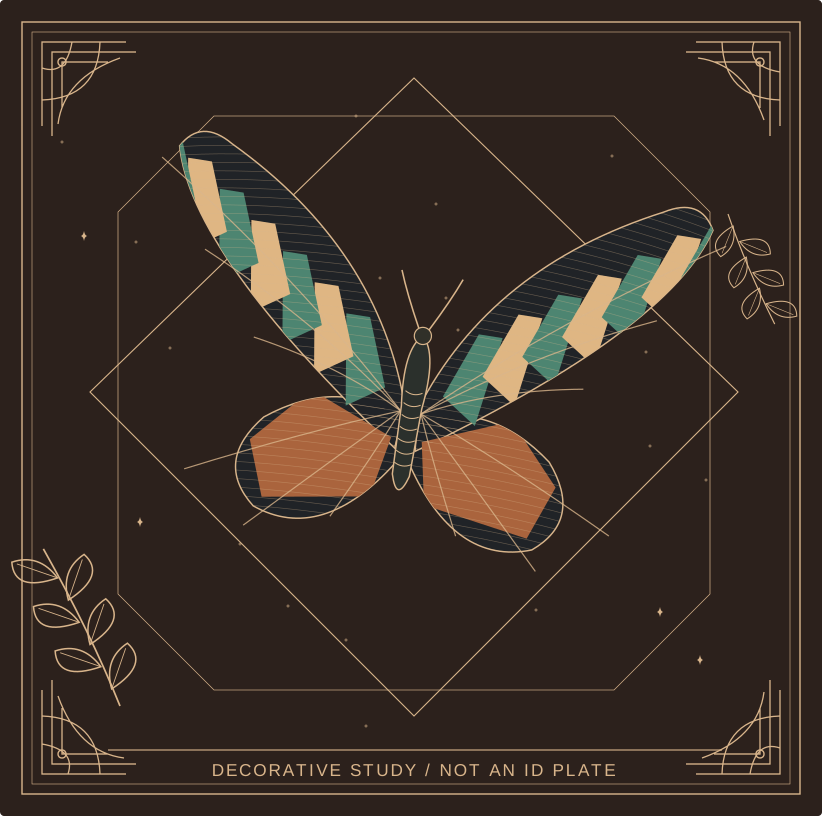
At a glance
- Activity ↘
- Day flight is recorded in Nepal. [2]
- Reported hosts ↘
- Lyonia, Rhododendron and Pinus are catalogue records. [4]
- Historic name ↘
- Older literature uses Chalcosia histrionica. [6]
Meet the species
The family Zygaenidae includes moths with very different forms. Campylotes belongs to its Chalcosiinae, and the Indian catalogue treats histrionicus among several named Campylotes species. That wider context matters: a dramatic patterned wing can introduce the genus, but a diagnosis must distinguish this animal from its relatives. The scientific name leads more reliably through those distinctions than the informal artwork label Harlequin Moth. [4][1]
Look closely
The Naturalis reference shows dark forewings with pale yellow marks and warmer orange areas on the hindwings, crossed by dark markings. Look at the relationship between those areas and the veins, rather than taking a color alone as a diagnostic character. A side-by-side image comparison is a useful start, while accurate identification may depend on specialist characters not visible in an artistic rendering. [1]
Range and habitat
The 2026 Indian Zygaenidae catalogue places this moth in northern India, Afghanistan, Nepal and western China. Its type history begins in Nepal. The regional records establish parts of a geographical story, while each dated encounter retains its own locality rather than defining the limits of the entire range. [4][2]
The Nepal inventory records encounters in several named districts, including Kathmandu, Solukhumbu and Kaski. Those entries help put the moth into a landscape rather than an undifferentiated Asian map. An observation at a particular altitude and month establishes that the animal was found there; it does not define the lowest, highest or only place where the species lives. [2]
Life in stages
The moth develops through egg, caterpillar, pupa and winged adult stages. The caterpillar and the adult have different bodies and different roles in the life cycle. The available histrionicus records document names, adult encounters and reported foodplants, while a complete regional development timetable remains unestablished. [7]
Food and host plants
The 2026 Indian catalogue attributes leaf-feeding records to Lyonia ovalifolia and Rhododendron in the heath family Ericaceae, and also lists Pinus massoniana. It traces those entries to earlier literature. Treat the plants as documented associations with references, rather than as a tested interchangeable diet. The distinction is especially useful when a catalogue summarizes records gathered in different places and at different times. [4]
A living insect
The Nepal biodiversity inventory describes this moth as day-flying, correcting the familiar idea that every moth belongs to the night. Its seasonal records are local encounters. Day activity and the colorful adult together make an engaging natural-history portrait, while a global flight calendar requires observations from across the range. [2]
A remarkable detail
Its color scheme makes the moth look immediately at home in a collection of butterflies. The scientific surprise is that such a visual resemblance does not change its taxonomic identity or establish mimicry. Toxicity, warning coloration and imitation of another insect are functional explanations that need species-level evidence. A bright pattern is something we can see; the reason that pattern evolved is a separate question.
Connections in nature
The documented foodplant associations connect the moth to living vegetation, while the museum reference connects its adult form to a preserved record. These are complementary windows into the animal’s life. Plant feeding identifies one relationship, but does not by itself reveal population density, predator avoidance or the moth’s effect on a whole ecosystem. An honest account keeps those different scales visible. [4]
Names and discovery
Historical catalogues can place the insect under Chalcosia histrionica. Swinhoe’s nineteenth-century Oxford catalogue preserves that older naming context, while modern sources use Campylotes histrionicus. Connecting the names helps readers find older specimens and literature. It also reveals one of the quiet values of museum collections: carefully preserved objects and labels can remain useful long after the taxonomic arrangement surrounding them changes. [6][3]
Conservation context
A species account and a conservation assessment answer different questions. This guide does not assign a global threat category from the presence of specimens in collections or shops. A documented locality establishes an occurrence; it does not measure population size or trend. When learning more about conservation, check that an assessment concerns the same taxon, place and date. The collection or breeding history of an individual specimen must be established separately from the species’ natural range.
Reading the specimen
Dorsal means the upper surface; ventral means the underside. A reverse view can reveal information hidden by a spread upper view, but it represents the same animal. Compare orientation before comparing pattern. The pose, lighting and background of a mount can emphasize some features and conceal others. Neither a color-matched illustration nor an attractive spread photograph supplies a collecting locality, a sex determination or a subspecies identification by itself.
In the artwork
Saved works include The Lovers, The Universe, The Star and The Mystical Wheel. Each composition uses the moth as an artistic presence, and each keeps its own title and edition. The repeated biological name connects them to one species account. A celestial background or a tarot title neither creates a new taxon nor supplies a natural-history explanation for the wing colors.
Care for the artwork
Place a framed specimen where you can enjoy its details in indirect light. Keep it away from damp rooms, radiators and abrupt changes of temperature. Handle the frame by its edges and keep the case closed; a wing, antenna or leg is more vulnerable than the surrounding glass suggests. Clean only the exterior, following the frame maker’s instructions, and avoid spraying liquid toward seams. If you notice loose fragments, moisture inside the case or signs of insect activity, photograph the change and seek conservation advice instead of opening the mount or applying a household pesticide.
Questions worth asking
Is this a butterfly? It is a day-flying moth. Does the name Harlequin Moth uniquely identify it? That informal label can be used in artwork descriptions, so Campylotes histrionicus is the reliable research name. Is it poisonous because it is brightly colored? This guide does not make that species-specific claim. Are the catalogue’s plants guaranteed rearing instructions? They are attributed records, not a universal diet.
Explore the sources
The linked records serve different purposes: taxonomy establishes the name used here, field observations describe a place and population, and experiments explain a tested mechanism. Read those scopes alongside the photographs. A locality in a scientific paper belongs to its study material, not automatically to the insect behind a particular artwork.
- Illustrated Zygaenidae reference ↗
Naturalis Biodiversity Center · Accessed 2026-10-09
Campylotes histrionicus adult appearance and regional collection information Collection month and elevation are local records, not species-wide limits.
- Nepal biodiversity inventory, volume 2, 1997 ↗
IUCN library · Accessed 2026-10-09
Day-flying behavior and local Nepal occurrence information, page 121 An inventory hosted by IUCN is not an IUCN Red List assessment.
- Campylotes histrionicus taxonomy ↗
GBIF · Accessed 2026-10-04
Zygaenidae / Campylotes identity Database status is not a specimen identification.
- A catalogue of Zygaenidae from India, 2026 ↗
Zootaxa · Accessed 2026-10-09
Campylotes histrionicus name, Nepal type context, reported regional range and host records Host entries are compiled records; no fixed global life-cycle schedule established.
- Author copy of Indian Zygaenidae catalogue ↗
Author-posted copy of Zootaxa paper · Accessed 2026-10-09
Species entry, printed page 11, indexed text Same work as CH2, not independent evidence.
- Swinhoe 1892 catalogue of Oxford Lepidoptera ↗
Historic Oxford collection catalogue via Wallace Online · Accessed 2026-10-04
Historical Chalcosia histrionica combination Historical names require mapping to modern taxonomy; no modern abundance inference.
- Metamorphosis: a remarkable change ↗
David Britton; Australian Museum · Accessed 2026-10-09
Order-level complete-metamorphosis background, not Campylotes duration.
Artworks in the collection
Explore the framed works and digital art connected with this insect. Etsy shows current availability, options and prices.
- The Lovers ↗Framed work
- The Universe ↗Framed work
- The Star ↗Framed work
- The Mystical Wheel ↗Framed work
Continue exploring
Sources checked 2026-10-09. Artwork © Scott Schubr / Luminary Oddities.
Return to the Entomological Atlas ↑