
Luminary Oddities · Natural history & art
Madagascan Sunset Moth
Chrysiridia rhipheus
Lepidoptera / Uraniidae
A day-flying Madagascan moth with color shaped by microscopic wing architecture and an intimate connection to Omphalea plants.
Explore this insect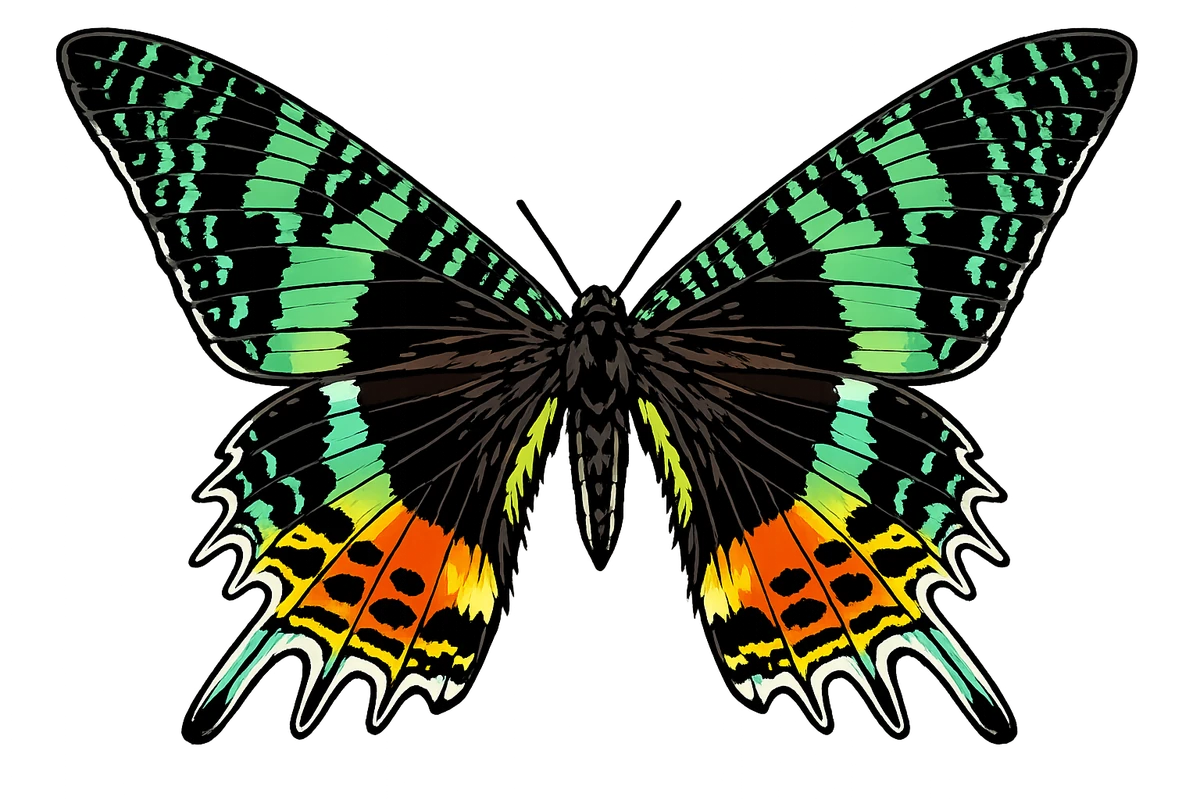
At a glance
- Identity ↘
- A day-flying moth in Uraniidae. [2][1]
- Larval food ↘
- Omphalea plants are documented hosts. [1]
- Wing science ↘
- Air–cuticle multilayers contribute to structural color. [3]
Meet the species
The Madagascan sunset moth is a reminder that a moth need not be a small brown visitor to a lamp. Chrysiridia rhipheus flies by day and belongs to Uraniidae. Its brilliant wings and tailed outline invite comparison with butterflies, while its classification opens a different natural-history story. [2]
Afromoths places Chrysiridia rhipheus in Uraniidae and records the original name under Papilio. Its current moth identity is therefore not obvious from every old label. The database also distinguishes synonyms from misapplied names, a useful reminder that a historic spelling or combination may refer to the same taxon, a mistaken attribution, or something that needs further interpretation. [1]
Look closely
Research into the wings shows that layers of air and cuticle contribute to optical interference, producing vivid structural colors. The effect is present on both the upper and lower surfaces, making a correctly labeled reverse view especially worthwhile. The mechanism should not be stretched into a claim that the entire moth is pigment-free. The dark ground scales have pigmentation, so the wing’s appearance combines different materials and optical effects within the same small surface. [3]
Look across the wing from a dark area into a bright one, then compare upper and lower surfaces. In the optical study, the arrangement and thickness of microscopic layers varied across the wing. The dorsal surface changed more gradually between scales, whereas distinct boundaries occurred on the ventral hindwing. The visual richness is not simply one uniform coating laid over the insect. [3]
Range and habitat
The accepted Afromoths record is Madagascan. Its listed hosts include several Malagasy Omphalea species, making plant geography an important part of the moth’s island story. A country record is a sensible geographical anchor for this guide. A precise origin for the specimen behind an artwork, or a continuous map of all its populations, would require different evidence. [1]
Life in stages
The adult’s spectacular wing surface belongs to the final stage of a complete metamorphosis. Oxford’s museum account emphasizes a continuity across development: defensive compounds from the larval foodplant remain into adulthood. The feeding larva and the brightly colored adult are therefore connected chemically as well as developmentally. This relationship says more than a universal, unsupported estimate of how many days the cycle takes. [2]
Food and host plants
Afromoths records the species from Madagascar and compiles hosts in the genus Omphalea, including several named Malagasy plants. Oxford’s account explains a biological connection between those plants and the adult: toxins acquired from the host can remain through development, while conspicuous adult colors act as a warning. That is a supported ecological story. It should not become a claim that every predator is deterred, or a suggestion that the preserved specimen should be handled as an experiment. [1][2]
Afromoths lists Omphalea ankaranensis, O. occidentalis, O. oppositifolia and O. palmata among the documented foodplants. It also flags an old mango record as probably wrong. That small correction is valuable: a long host list is not necessarily a better host list. Records carry different histories and confidence, and the database preserves those distinctions rather than flattening them. [1]
A living insect
Oxford describes a day-flying moth whose bright appearance acts as warning coloration. That supported species story should not become an assertion that every predator always avoids it. Day flight also explains why this animal can be encountered in the same visual world as butterflies. The familiar butterfly-versus-night-moth division is a convenient image, not a complete account of Lepidoptera. [2]
A remarkable detail
The same wing supplies both a biological pattern and an optical experiment. Alternating air and cuticle layers influence which light is reflected, while their dimensions change across different colored regions. This is structural color, but it does not make every part of the wing pigment-free. The dark ground scales remain part of the complete appearance, and a printed reproduction cannot recreate the physical multilayer architecture. [3]
Connections in nature
A broader study of uraniine moths describes young larvae feeding between leaf veins and older Chrysiridia larvae using leaves, fruit, tendrils and young stems. This is a genus- and subfamily-level comparison, rather than an experiment confined to the Madagascan sunset moth. The authors reported no observed vein-cutting. The findings describe how larvae use plant tissues without establishing that they cut veins to interrupt latex. [4]
Names and discovery
The name’s recorded history contains a geographic trap: Afromoths flags a historical China locality as erroneous. Its real island context is Madagascar. That correction shows how scientific records can preserve a historical attribution while also questioning it. Sunset, celestial and tarot themes provide another kind of story in the collection, belonging to the artist’s interpretation of the moth. [1]
Conservation context
A species account and a conservation assessment answer different questions. This guide does not assign a global threat category from the presence of specimens in collections or shops. A documented locality establishes an occurrence; it does not measure population size or trend. When learning more about conservation, check that an assessment concerns the same taxon, place and date. The collection or breeding history of an individual specimen must be established separately from the species’ natural range.
Reading the specimen
Dorsal means the upper surface; ventral means the underside. A reverse view can reveal information hidden by a spread upper view, but it represents the same animal. Compare orientation before comparing pattern. The pose, lighting and background of a mount can emphasize some features and conceal others. Neither a color-matched illustration nor an attractive spread photograph supplies a collecting locality, a sex determination or a subspecies identification by itself.
In the artwork
The sunset moth’s real wing pattern provides a rich starting point for the specimen-derived digital collection. A stylized work may emphasize a line, a hue or a luminous edge while retaining the original animal’s structure. Those artistic choices are easiest to appreciate when compared across correctly captioned upper and lower views. The digital palette expresses the work; it is not a calibrated measurement of a living wing.
Care for the artwork
Place a framed specimen where you can enjoy its details in indirect light. Keep it away from damp rooms, radiators and abrupt changes of temperature. Handle the frame by its edges and keep the case closed; a wing, antenna or leg is more vulnerable than the surrounding glass suggests. Clean only the exterior, following the frame maker’s instructions, and avoid spraying liquid toward seams. If you notice loose fragments, moisture inside the case or signs of insect activity, photograph the change and seek conservation advice instead of opening the mount or applying a household pesticide.
Questions worth asking
Is it a butterfly? It is a moth, even though it flies by day. Does it live in China? The accepted Afromoths record identifies the old China locality as an error and places the species in Madagascar. Is all its color structural? The optical account distinguishes iridescent structures from pigmented dark scales. Do all the cited larval behaviors come from this one species? Some feeding comparisons have genus or subfamily scope.
Explore the sources
The linked records serve different purposes: taxonomy establishes the name used here, field observations describe a place and population, and experiments explain a tested mechanism. Read those scopes alongside the photographs. A locality in a scientific paper belongs to its study material, not automatically to the insect behind a particular artwork.
- Chrysiridia rhipheus species and host record ↗
Afromoths · Accessed 2026-10-09
Exact URL retained. Madagascar; original China locality erroneous; Omphalea hosts; mango record probably erroneous.
- Madagascan sunset moth natural-history account ↗
Oxford University Museum of Natural History · Accessed 2026-10-09
Exact URL retained. Day flight, warning coloration, larval host toxins retained into adulthood.
- Coloration using higher order optical interference in the wing pattern of the Madagascan sunset moth ↗
Yoshioka and colleagues; Journal of the Royal Society Interface (2008), author institution record · Accessed 2026-10-09
Exact URL retained. Air–cuticle interference on both wing surfaces; dark ground scales remain pigmented.
- Food Plant Associations of the Uraniinae (Uraniidae) and Their Systematic, Evolutionary, and Ecological Significance ↗
Lees and Smith, Journal of the Lepidopterists’ Society 45(4), 1991 · Accessed 2026-10-04
Lees and Smith 1991, p.325: uraniine early intervein feeding; later Urania/Chrysiridia feeding on leaves, fruits, tendrils and young stems. No observed vein-cutting. Genus/subfamily scope, not a rhipheus-only experiment.
Artworks in the collection
Explore the framed works and digital art connected with this insect. Etsy shows current availability, options and prices.
- Chaos ↗Framed work
- The Universe ↗Framed work
- Wheel of Fortune ↗Framed work
- Chaos ↗Framed work
- Black / Midnight / Sapphire editions ↗Framed work
- Madagascan Sunset Moth PNG Bundle | 16 Chrysiridia rhipheus 300 DPI Digital Clipart Files ↗Digital artwork
Continue exploring
Sources checked 2026-10-09. Artwork © Scott Schubr / Luminary Oddities.
Return to the Entomological Atlas ↑