
Luminary Oddities · Natural history & art
Indian Moon Moth
Actias selene
Lepidoptera / Saturniidae
Pale green wings, crescent eyespots and long tails give the Indian moon moth its celestial silhouette. A local life-history study reveals the feeding caterpillar behind that delicate adult.
Explore this insect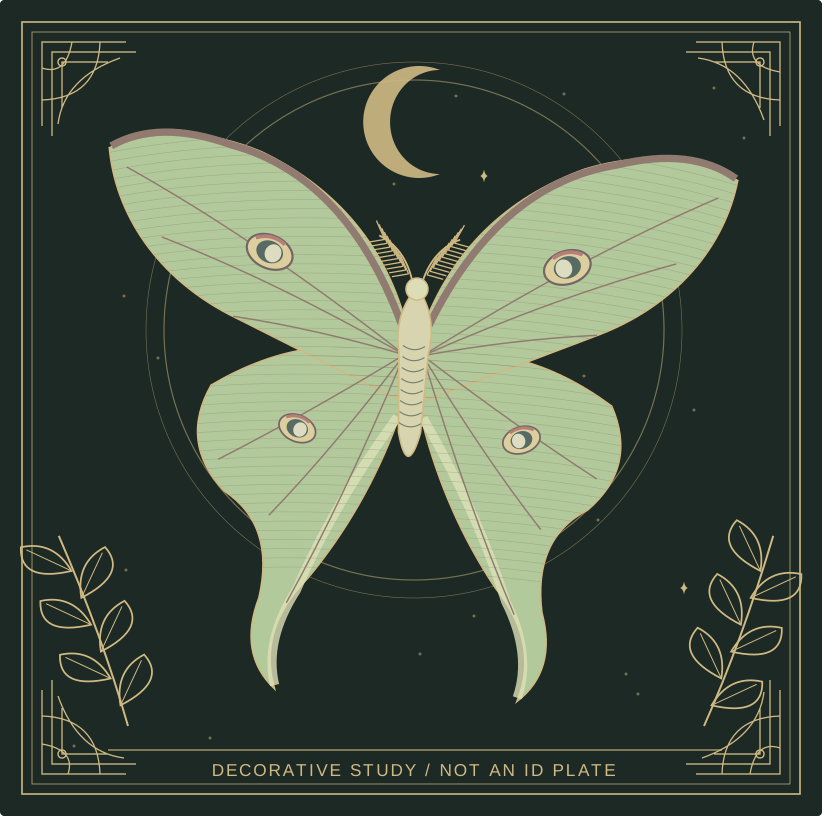
At a glance
- Identity ↘
- A moon moth in Saturniidae. [2]
- Local cycle ↘
- Three generations were recorded in the Nagaland study. [3]
- Adult phase ↘
- The adult does not feed. [2]
Meet the species
Older literature used the name Actias selene broadly. Modern taxonomic resources separate Actias ningpoana, once treated under selene, and Moths of Borneo flags uncertainty around some regional material. A sweeping range or host list copied from an old account may therefore combine more than one modern species. The historical species complex and a studied local population each carry their own natural-history evidence. [1]
The name belongs to the giant silk-moth family Saturniidae. The similarly tailed North American Actias luna is a different species, with its own range and experiments. A common name can introduce a moth, but the scientific name is what connects the specimen to a particular body of evidence. This account retains Actias selene while distinguishing the historical species complex from observations made on a named local population. [2][1]
Look closely
Actias selene has the moon-moth silhouette: pale green wings, rounded eyespots and long hindwing tails. Moths of Borneo describes a pale emerald ground color and a dark crescent at the forewing eyespot. That overall form identifies a useful group of features to examine, while a specimen’s sex and regional identity require their own records. [1][2]
Notice where the crescent sits within the forewing eyespot, then follow the vein lines toward the wing margin and the hindwing tail. Looking at the arrangement is more informative than simply calling the moth green. The monograph’s comparison with Actias maenas combines tail length and the eyespot pattern; several moon moths share the broad silhouette. [1]
Range and habitat
The historical Moths of Borneo account covers Asian material and notes regional uncertainty in Sundaland. Its forest records belong to that account’s geographical and taxonomic setting. Nagaland provides a more precise anchor for the life-history study below. Neither source establishes where the insect represented in a particular artwork was collected or bred. [1][3]
Life in stages
A 2010 study in Nagaland provides a concrete local life history. Researchers reared the moth on Alnus nepalensis and Rhus javanica and documented changing larval colors and tubercles as the caterpillars grew. The population studied produced three generations in the local annual cycle, with a winter pause at the pupal stage. These observations bring the animal’s transformations into focus without turning them into a universal timetable. The same calendar cannot simply be imposed on populations living under different climates or on related species once included under the same name. [3]
Egg, caterpillar, pupa and adult are different stages, each with a different appearance. The Nagaland researchers compared three rearing seasons over two years. Their measured variation in duration and cocoon production demonstrates why a single fixed number is a poor description of the moth’s entire life. Winter pupal dormancy is a local result with a place and a climate attached. [3]
Food and host plants
Alnus nepalensis is an alder and Rhus javanica a sumac: these are the two plants used in the cited Nagaland rearing experiment. The authors’ comparison connects plant choice to the larvae’s development. A successful laboratory or captive rearing plant is a specific observation, not a universal prescription for every wild population. Older host lists deserve additional care where the name selene covered more than one taxon. [3]
A living insect
The Hong Kong Biodiversity Museum describes adult moon moths as nonfeeding, with reduced mouthparts. Energy acquired during the caterpillar stage therefore supports the adult phase. Its account also describes nocturnal activity and male searching guided by the female’s chemical signals. Those details connect the spectacular adult to the less conspicuous larva: the moth’s final winged stage depends on resources accumulated before emergence. [2]
A remarkable detail
A long tail invites comparison with research on other moon moths. Experiments on Actias luna show that tails can divert the attacks of echolocating bats. Those results belong to luna, rather than demonstrating a function for Actias selene. Similar anatomy raises an interesting scientific question; establishing the answer requires the right species and an appropriate experiment.
Connections in nature
The plant-feeding caterpillar and nonfeeding adult are linked by development rather than by a shared diet. The Nagaland study makes that relationship tangible by measuring rearing performance on named plants. For a visitor looking only at the adult, it is easy to overlook the foliage that made the wings possible. Host records bring that less visible part of the insect’s story back into view. [3]
Names and discovery
The name Selene connects the moth to the Greek moon goddess in the museum’s interpretation, a fitting association for the moon-moth form. It is a naming allusion, not evidence that the insect held the same spiritual meaning in every place it lives. A framed work may offer its own lunar symbolism, but that belongs to the artwork’s story and should be identified as an artistic choice. [2]
Conservation context
A species account and a conservation assessment answer different questions. This guide does not assign a global threat category from the presence of specimens in collections or shops. A documented locality establishes an occurrence; it does not measure population size or trend. When learning more about conservation, check that an assessment concerns the same taxon, place and date. The collection or breeding history of an individual specimen must be established separately from the species’ natural range.
Reading the specimen
Dorsal means the upper surface; ventral means the underside. A reverse view can reveal information hidden by a spread upper view, but it represents the same animal. Compare orientation before comparing pattern. The pose, lighting and background of a mount can emphasize some features and conceal others. Neither a color-matched illustration nor an attractive spread photograph supplies a collecting locality, a sex determination or a subspecies identification by itself.
In the artwork
The saved framed-artwork record associates this moth with The Universe. Its lunar outline can support a composition about cycles, light or cosmic scale, while remaining an individual biological form. An artwork title is the artist’s interpretation of the specimen’s presence. It does not establish a traditional cultural meaning, a species name or a separate biological form.
Care for the artwork
Place a framed specimen where you can enjoy its details in indirect light. Keep it away from damp rooms, radiators and abrupt changes of temperature. Handle the frame by its edges and keep the case closed; a wing, antenna or leg is more vulnerable than the surrounding glass suggests. Clean only the exterior, following the frame maker’s instructions, and avoid spraying liquid toward seams. If you notice loose fragments, moisture inside the case or signs of insect activity, photograph the change and seek conservation advice instead of opening the mount or applying a household pesticide.
Questions worth asking
Is it the same animal as the luna moth? This guide follows Actias selene, not Actias luna. Do all green moon moths share the same timetable? The cited three-generation cycle belongs to Nagaland. Can its adult be described as a flower visitor? The museum describes nonfeeding adults, so a flower in the composition belongs to the artwork rather than to a documented nectar-feeding behavior.
Explore the sources
The linked records serve different purposes: taxonomy establishes the name used here, field observations describe a place and population, and experiments explain a tested mechanism. Read those scopes alongside the photographs. A locality in a scientific paper belongs to its study material, not automatically to the insect behind a particular artwork.
- Actias selene ↗
Moths of Borneo · Accessed 2026-10-09
Pale emerald wings, forewing eyespot crescent and taxonomic uncertainty in Sundaland Older broad usage includes unresolved regional identities.
- Specimen showcase: Moon goddess, 10 March 2025 ↗
Hong Kong Biodiversity Museum · Accessed 2026-10-09
Adult vestigial mouthparts/nonfeeding, sexual differences, nocturnal pheromone search and Selene name context Excluded unsupported largest-species, 10 km pheromone, silk-length and rigid life-cycle numerical claims.
- Nagaland rearing study of Actias selene, 2010 ↗
Lepidoptera Science · Accessed 2026-10-09
Nagaland rearing study: local generations, pupal winter dormancy, host comparison and changing larvae.
Artworks in the collection
Explore the framed works and digital art connected with this insect. Etsy shows current availability, options and prices.
- The Universe ↗Framed work
Continue exploring
Sources checked 2026-10-09. Artwork © Scott Schubr / Luminary Oddities.
Return to the Entomological Atlas ↑