

Luminary Oddities · Natural history & art
Pink Spirit Moth
Actias rhodopneuma
Lepidoptera / Saturniidae
A moon moth represented in the collection by pink-and-yellow specimen-derived works. Published Laotian and Chinese records anchor its identity while its early life remains less fully documented here.
Explore this insect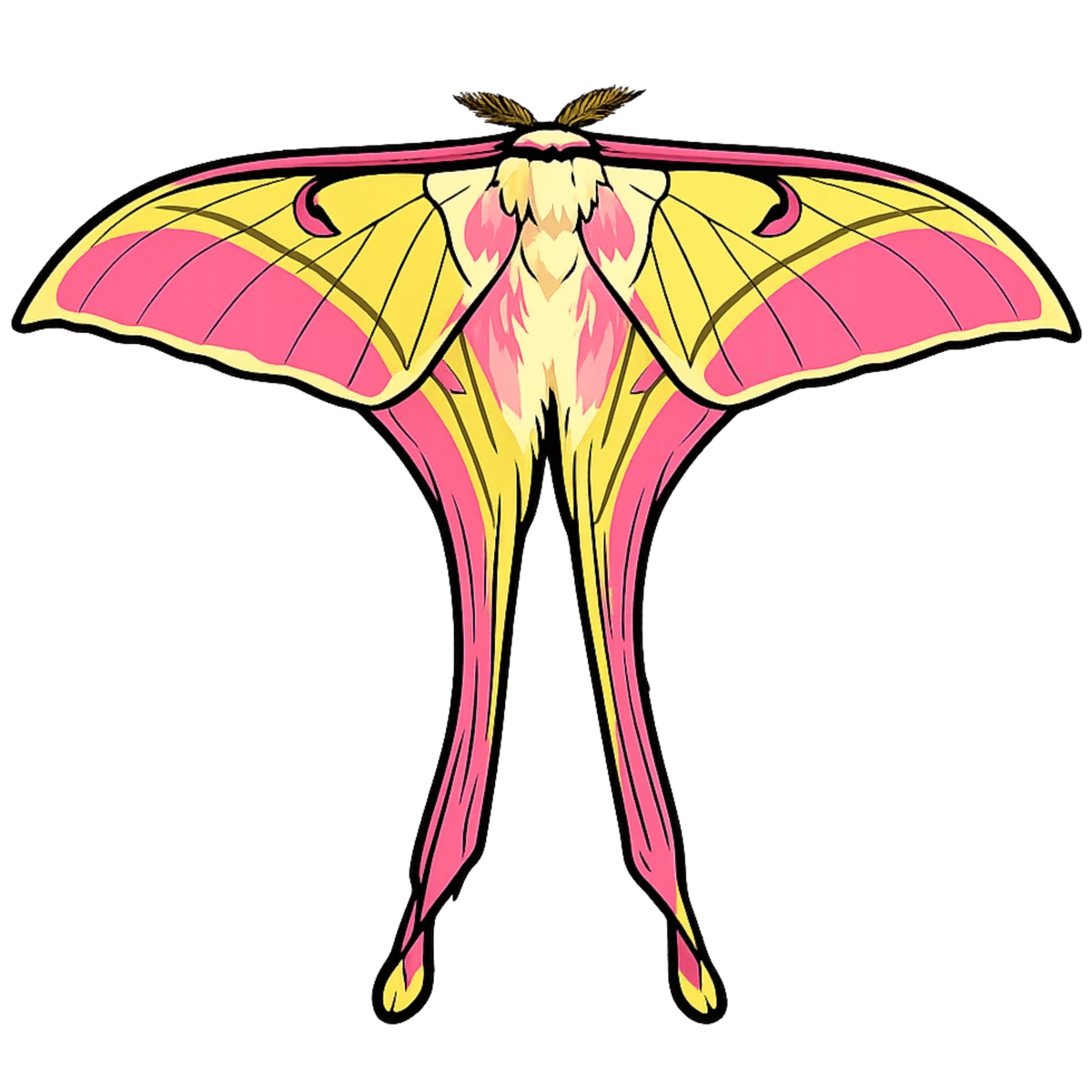
At a glance
- Recorded habitat ↘
- Mountain tropical forest in Phongsaly, Laos. [2]
- Earlier name ↘
- Euandrea rhodopneuma Röber, 1925. [1]
Meet the species
Actias rhodopneuma is a moon moth in Saturniidae. The scientific literature recognizes it separately from the North American Actias luna and the Asian Actias selene. Its original name was Euandrea rhodopneuma, published by Röber in 1925; the present genus places it among other Actias moths. [1]
Pink Spirit Moth is the name used for the associated digital works. A poetic common name can make an insect memorable, while its scientific name connects it to a particular record. Chinese Luna Moth also appears in the artwork folders, so reading the individual listing and scientific name together avoids confusing this species with other green or long-tailed moon moths.
Look closely
The saved dorsal composition emphasizes a pale yellow body and wing field, rose-pink accents, feathered antennae and long hindwing tails. Those observations describe the photographed artwork and its treatment. They are a starting point for enjoying the composition, rather than a complete diagnostic description of every wild rhodopneuma.
Look first at the join between the broader hindwing and the slender tail, then follow the pink areas around the wing margins and across the upper wings. Changing the background can make a narrow tail more or less visible. Dorsal and ventral views describe different orientations, so a palette difference between them should not automatically be read as variation between two insects.
Range and habitat
The 2025 Laos revision reports examined adults from mountain tropical forest in Phongsaly Province and records rhodopneuma there for the first time. It also lists earlier evidence from Luang Prabang and Houaphan. Those are documented components of the Laotian range, not a claim that the species occurs in every province. [2]
An older specimen-based account examined two males labeled from Luang Prabang at 1,800 metres, collected in June 1997. The elevation belongs to those labels. It cannot establish a universal lower or upper habitat limit, and the collection month is an occurrence date rather than a complete flight-season calendar. [3]
The Kunming Institute of Zoology’s forest-insect database lists rhodopneuma from Yuanyang and Huize in Yunnan, China. This adds a Chinese regional context to the Laotian records. None of these scientific localities identifies where the specimen behind a particular digital work was collected. [4]
Life in stages
As a lepidopteran, this moth develops through egg, caterpillar, pupa and adult stages. The caterpillar has chewing mouthparts; the adult is a different developmental form. A pupa is the changing insect, while a cocoon, where one is formed, is its surrounding shelter. Keeping those terms separate helps make sense of life-history photographs. [5]
The cited rhodopneuma records document adults. They do not establish a complete schedule for eggs, larval growth, pupation or dormancy. Temperature and provenance would need to accompany any rearing observations before a duration could be interpreted. A timetable from another Actias species should therefore remain attached to that other species.
Food and host plants
The linked moth records do not supply a verified wild-host list for rhodopneuma. A plant used successfully in captivity answers a different question from a plant on which a wild female lays eggs and her larvae develop. A robust food account needs the moth identification, plant identification, locality and developmental outcome together.
Moth larvae commonly consume plant material, but adult feeding varies across Lepidoptera. Some adults feed through a proboscis and others do not feed. That general diversity is a reason to avoid assuming that this species drinks nectar, pollinates a particular flower or shares an exact feeding physiology with every other moon moth. [6]
A living insect
The collection dates in the published Laos accounts tell us that adults were present when those specimens were obtained. They do not by themselves describe courtship, daily flight rhythm, migration or an annual emergence peak. A behavior claim needs observations of activity rather than a mounted adult alone. [3]
A flight-shaped artwork captures an expressive pose. It can bring attention to the tail and the sweep of the wings without reproducing a measured flight sequence. When looking at the gallery, enjoy the movement in the composition and reserve conclusions about speed, maneuverability or sensory abilities for studies that actually test them.
A remarkable detail
The 2025 revision places images of identified male and female rhodopneuma alongside other Actias species. It also illustrates male genital morphology. The combination is instructive: a striking wing portrait is useful, but taxonomic work may depend on structures that are not visible in the artwork. [2]
The long tails naturally invite comparison with the bat-defense experiments discussed in the Actias luna guide. Those experiments tested named species and particular manipulations. A shared silhouette is not enough to transfer the same demonstrated mechanism to rhodopneuma. Comparative resemblance can suggest a question without settling the answer.
Connections in nature
The Phongsaly habitat description links identified adults to mountain tropical forest. The surrounding plant community, local seasonal conditions and undiscovered early stages are all parts of the ecological setting. The published adult records establish presence; they do not quantify the moth’s abundance, its food-web role or the condition of populations throughout its range. [2]
Names and discovery
The parenthesized authorship, (Röber, 1925), records that the species was first described in another genus. Euandrea rhodopneuma remains a useful historical search term. NCBI supplies that name history and lineage as database context; the primary Laos revision supplies the modern specimen-based usage of Actias rhodopneuma. [1]
A descriptive name in the art collection is part of the human response to the animal. Spirit imagery does not establish a traditional belief shared by people across its range. The Atlas keeps the work’s title visible while allowing the taxonomic history to carry its own documented meaning.
Conservation context
The cited sources describe distribution records and identification. They do not establish a current global threat category or a population trend. A new provincial record can represent better documentation rather than a recent range expansion, just as a small number of examined specimens cannot by itself measure rarity.
Dates and locality labels are valuable because future surveys can return to the same region and ask more specific questions. Keeping specimen provenance with an artwork protects that information even when the image is reinterpreted, printed or incorporated into a new composition.
Reading the specimen
Compare dorsal and ventral views as views of different surfaces. Read the caption before using color as an identification cue. On a digital image, an enlarged view can help reveal the tail’s outline and the placement of wing marks; it cannot restore a hidden anatomical structure or supply missing specimen documentation.
In the artwork
The Pink Spirit Moth digital packs transform specimen photography into distinct presentations. Their pink and yellow accents, elongated tails and altered orientations make the body’s outline central to the compositions. A change in finish belongs to the artwork. It should not be interpreted as a new biological form or evidence for a different locality.
Care for the artwork
For a digital work, keep the original download and its license together, and make a backup before cropping or preparing a print. Choose paper, inks and framing for the display location; a bright screen preview and a paper print will not necessarily look identical. Avoid direct sunlight and damp locations for a finished print. The insect-derived artwork is an interpretation of the original photograph, so resizing it or changing its color balance changes the artwork rather than the biological specimen.
Questions worth asking
Is it the same moth as Actias luna? No; the guides concern separately named species. Does an adult collection date show the entire flight season? No; it shows an occurrence at that time. Can another moon moth’s host list fill the gaps? Only as a clearly labeled comparison, not as confirmed rhodopneuma biology. Are dorsal and ventral artworks automatically different specimens? Their captions describe orientation, and the source records determine specimen identity.
Explore the sources
The linked records serve different purposes: taxonomy establishes the name used here, field observations describe a place and population, and experiments explain a tested mechanism. Read those scopes alongside the photographs. A locality in a scientific paper belongs to its study material, not automatically to the insect behind a particular artwork.
- Taxonomy Browser: Actias rhodopneuma ↗
NCBI Taxonomy · Accessed 2026-10-09
Database name history and lineage; primary revision used for modern species treatment.
- The Brahmaeidae and Saturniidae of Laos ↗
Spitsyn and colleagues; Ecologica Montenegrina 84 (2025), author copy · Accessed 2026-10-09
Examined Laotian adults, habitat, regional records and identified illustrations; not an early-stage or feeding study.
- Further records of Saturniids from Laos ↗
Racheli, Vinciguerra and Racheli; SHILAP 36 (2008) · Accessed 2026-10-09
Two examined Luang Prabang male specimens with 1997 locality/elevation/date labels.
- Yunnan forest-insect distribution database ↗
Kunming Institute of Zoology, Chinese Academy of Sciences · Accessed 2026-10-09
Regional database occurrences in Yuanyang and Huize; not exhaustive worldwide distribution.
- Metamorphosis: a remarkable change ↗
David Britton; Australian Museum · Accessed 2026-10-09
General complete-metamorphosis stages, not rhodopneuma development times.
- Moths, butterflies and skippers: Order Lepidoptera ↗
Australian Museum · Accessed 2026-10-09
Order-level feeding diversity; no species-specific adult feeding conclusion.
Artworks in the collection
Explore the framed works and digital art connected with this insect. Etsy shows current availability, options and prices.
Continue exploring
Sources checked 2026-10-09. Artwork © Scott Schubr / Luminary Oddities.
Return to the Entomological Atlas ↑