
Luminary Oddities · Natural history & art
White Ghost Cicada
Ayuthia spectabile
Hemiptera / Cicadidae
Opaque cream and transparent membrane meet in the wings of this Southeast Asian cicada, revealing a very different kind of insect surface from a moth’s scales.
Explore this insect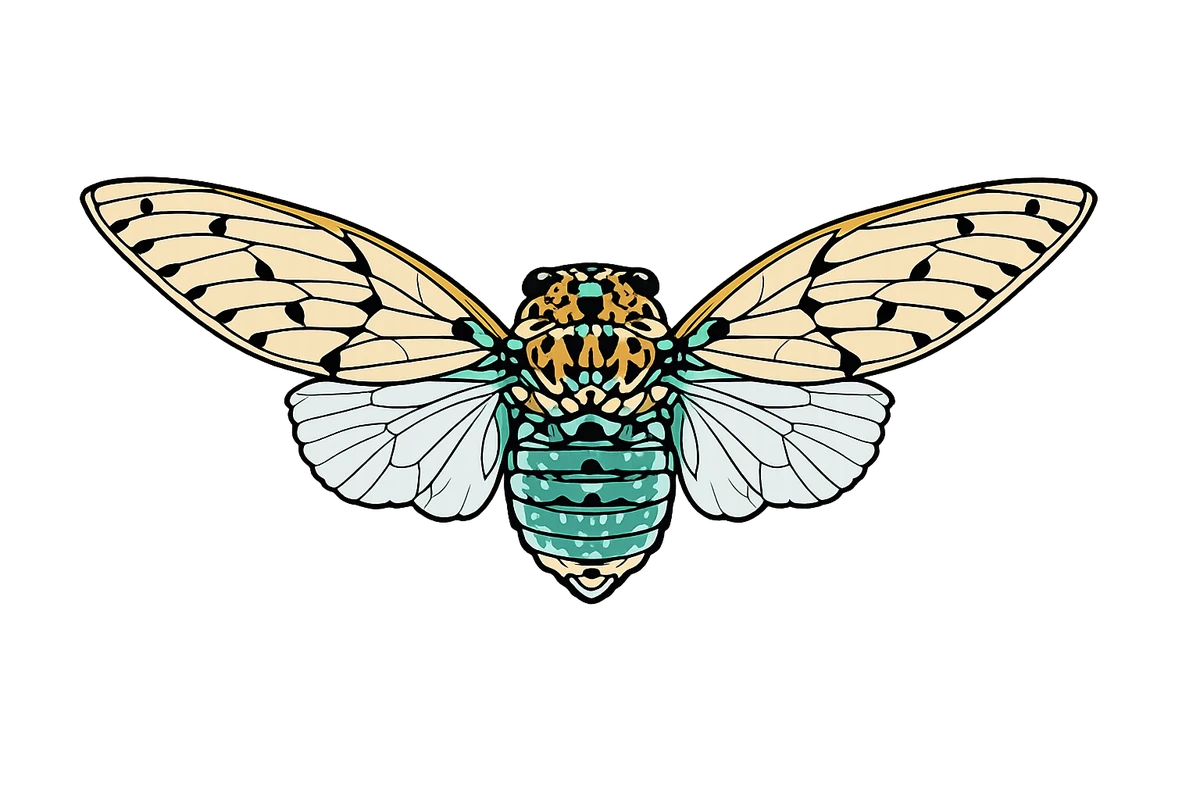
At a glance
- Selected spelling ↘
- Ayuthia spectabile, described in 1919. [1]
- Range records ↘
- The Thai checklist includes Indochina and the Malay Peninsula. [4]
- Name meaning ↘
- The specialist record interprets spectabile as outstanding. [1]
Meet the species
This is a cicada in Cicadidae and Hemiptera. Its specialist taxonomic record preserves spectabile, rather than the frequently substituted spectabilis. Keeping that ending consistent makes it easier to connect the artwork to the original description and modern research. A common name such as White Ghost Cicada introduces the striking appearance, but the scientific spelling provides the reliable link. [1]
Look closely
A white area and a clear area are different physical features. When looking through an enlarged image, notice the change from creamy opacity into membrane through which the background can be seen. This contrast explains why a white-winged artistic silhouette can lose useful detail if it treats the whole forewing as solid. The original description preserves that distinction at the scale of the adult insect. [3]
Range and habitat
The 2007 Thai checklist’s species treatment gives Indochina, the Malay Peninsula and Thailand as its compiled distribution. The World Auchenorrhyncha Database also presents museum specimens labelled from Tapah Hills in Perak, Malaysia. Together these provide a Southeast Asian setting. They do not establish one forest type, an exact altitude range or the origin of a specimen in a shop’s framed work. [4][1]
Life in stages
The broader cicada sequence is egg, nymph and adult, with no intervening pupa. Underground nymphs have a different appearance and setting from the conspicuous winged adult. The final molt is the transition that produces the adult form. This family background explains why a butterfly-style caterpillar and chrysalis diagram would misrepresent Ayuthia, even if its wings look unusually pale and delicate. [7]
Food and host plants
Cicadas have piercing mouthparts and feed on plant fluids. Root-associated nymphal feeding is part of the family’s life history, but it does not identify a particular host tree for Ayuthia. A verified plant association must distinguish a feeding observation from an insect resting on bark or leaves. This article therefore keeps the general feeding mode separate from a species-specific host list that the sources do not establish. [7]
A living insect
A living cicada’s signal comes from specialized sound-producing anatomy, rather than from the visual impression of the wings alone. The museum’s family account is a useful introduction to that machinery. It should not be converted into an Ayuthia call recording, a daily chorus schedule or a claim about the sex of the framed specimen. A voice needs its own identified observation. [7]
A remarkable detail
The laboratory studies investigated transparent forewing surfaces at microscopic scale. That is a different question from why other parts of the wing appear creamy white. A scientist can examine tiny structures and test bacterial interactions without having explained the whole visible color pattern. Keeping the two scales distinct makes the research more interesting: one wing can contain several separate materials and mechanisms. [5][6]
Connections in nature
Ayuthia contributes an instructive comparison to the wing-surface experiments. The strongest bacterial-killing results in the cited comparison belonged to other tested cicadas. That contrast shows why similar-looking surface structures do not justify identical performance claims for every species. None of those laboratory outcomes establishes the ecological function of the pale adult wing, and none makes a preserved work a sterile or self-cleaning object. [5]
Names and discovery
Distant’s 1919 description introduced the genus and species. The World Auchenorrhyncha Database interprets the epithet through a Latin meaning of noteworthy or outstanding. That name is a historical and linguistic detail, not a supernatural explanation of the white appearance. Scientific names can be evocative while still serving the practical task of locating the same animal in collections and literature. [1]
Conservation context
A species account and a conservation assessment answer different questions. This guide does not assign a global threat category from the presence of specimens in collections or shops. A documented locality establishes an occurrence; it does not measure population size or trend. When learning more about conservation, check that an assessment concerns the same taxon, place and date. The collection or breeding history of an individual specimen must be established separately from the species’ natural range.
Reading the specimen
Dorsal means the upper surface; ventral means the underside. A reverse view can reveal information hidden by a spread upper view, but it represents the same animal. Compare orientation before comparing pattern. The pose, lighting and background of a mount can emphasize some features and conceal others. Neither a color-matched illustration nor an attractive spread photograph supplies a collecting locality, a sex determination or a subspecies identification by itself.
In the artwork
The saved works include The Moon, White Edition and Beneath the Full Moon. Each title creates a setting for the pale-winged specimen. The lunar interpretation belongs to the composition; it does not identify a moon-linked behavior or a traditional cultural role for Ayuthia. Reflective backgrounds and frame finishes can change how the transparent areas read, so edition and view are useful parts of each caption.
Care for the artwork
Place a framed specimen where you can enjoy its details in indirect light. Keep it away from damp rooms, radiators and abrupt changes of temperature. Handle the frame by its edges and keep the case closed; a wing, antenna or leg is more vulnerable than the surrounding glass suggests. Clean only the exterior, following the frame maker’s instructions, and avoid spraying liquid toward seams. If you notice loose fragments, moisture inside the case or signs of insect activity, photograph the change and seek conservation advice instead of opening the mount or applying a household pesticide.
Questions worth asking
Are its wings entirely opaque white? The original account distinguishes creamy opaque areas from clearer areas. Does the surface research make it antibacterial artwork? The experiments do not support that product claim. Is spectabilis the selected scientific name? This account follows the specialist spelling spectabile. Does a photographed perch identify its larval host? A perch is an occurrence observation, not necessarily a feeding or breeding association.
Explore the sources
The linked records serve different purposes: taxonomy establishes the name used here, field observations describe a place and population, and experiments explain a tested mechanism. Read those scopes alongside the photographs. A locality in a scientific paper belongs to its study material, not automatically to the insect behind a particular artwork.
- World Auchenorrhyncha Database: Ayuthia spectabile ↗
World Auchenorrhyncha Database · Accessed 2026-10-09
Accepted spelling spectabile; Distant 1919; Cicadinae, Ayuthiini, Ayuthiina.
- Hill and colleagues 2021: cicada classification research ↗
Hill and colleagues; Invertebrate Systematics (2021) · Accessed 2026-10-09
Higher classification and genetic study; electa samples included Bach Ma National Park in Vietnam and a Chinese locality.
- Distant 1919: original description of Ayuthia spectabile ↗
Distant; Annals and Magazine of Natural History (1919) · Accessed 2026-10-04
Description at pages 43–44 supports mixed opaque and transparent wing pattern. Historical locality evidence must not become specimen provenance.
- Checklist of Thai cicadas, 2007 ↗
Sanborn, Phillips and Sites; Zootaxa (2007) · Accessed 2026-10-09
Species treatment gives Indochina, Malay Peninsula and Thailand distribution records.
- Cicada Wing Surface Topography: bactericidal properties of nanostructural features ↗
Kelleher and colleagues; ACS Applied Materials & Interfaces · Accessed 2026-10-09
DOI 10.1021/acsami.5b08309. Studies colourless forewings. Significant killing reported for Megapomponia intermedia and Cryptotympana aquila; do not attribute the same result to Ayuthia. The paper uses aguila in places.
- Biomimetic Polymer Surfaces by High Resolution Molding of the Wings of Different Cicadas ↗
Kelleher and colleagues; Materials (2021) · Accessed 2026-10-09
Distinguish natural wings from experimental polymer replicas.
- Australian Museum: Cicadas ↗
Australian Museum · Accessed 2026-10-09
Cicada-level background only. Do not transfer Australian emergence schedules to Asian species.
Artworks in the collection
Explore the framed works and digital art connected with this insect. Etsy shows current availability, options and prices.
- The Moon ↗Framed work
- White Edition ↗Framed work
- Beneath the Full Moon ↗Framed work
Continue exploring
Sources checked 2026-10-09. Artwork © Scott Schubr / Luminary Oddities.
Return to the Entomological Atlas ↑