
Luminary Oddities · Natural history & art
Moth-like Cicada
Gaeana maculata
Hemiptera / Cicadidae
Broad patterned wings make this cicada easy to mistake for a moth. Field observations and wing-surface experiments published as Gaeana cheni now sit within a revised taxonomic treatment.
Explore this insect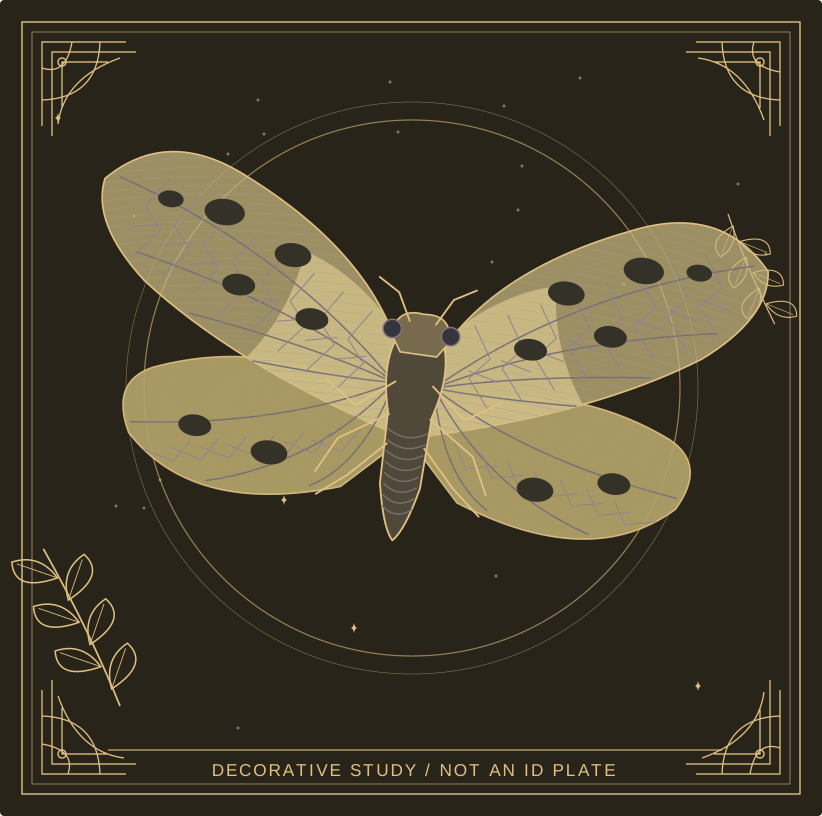
At a glance
- Revised identity ↘
- Gaeana cheni is treated as a synonym under maculata. [2]
- Local field life ↘
- Thai cheni observations describe sunny-canopy activity. [4]
- Laboratory detail ↘
- Wing-inspired polymer replicas repelled water strongly. [5]
- Life cycle ↘
- A cicada has nymphs rather than caterpillars or pupae. [6]
Meet the species
The heading follows Gaeana maculata. The 2025 treatment, reflected in the World Auchenorrhyncha Database, places Gaeana cheni as a subjective synonym under the nominal maculata subspecies. This guide retains cheni for searching earlier labels and experiments. It does not independently identify the framed individual to subspecies, nor assume that every historical cheni observation describes every maculata population. [2]
Look closely
In the Thai account published under cheni, the adult has a dark body, yellow forewing markings and paler hindwings with brown areas. Look at the broad wing proportions as well as the patches. The term moth-like describes an impression of the adult outline; it does not place the insect in Lepidoptera. This is a cicada in Hemiptera. [4]
Range and habitat
Boulard’s account supplies a particularly useful local setting: the forested Doi Mon Kia hills of northern Thailand. The original name and place should travel together when discussing those observations. A revised species boundary can broaden the taxonomic concept without turning one locality into a complete range map or making every population follow the same seasonal pattern. [4][2]
Life in stages
The Thai observations include nymphs leaving the ground and adults appearing during the local spring season. That final molt fits the broader cicada sequence of egg, nymph and adult. There is no chrysalis. The exact root plants and full underground development time are separate parts of the story that this account does not establish. [4][6]
Food and host plants
The museum’s general account describes plant-fluid feeding and root-associated underground nymphs. Those are cicada-family features, not a demonstrated host list for historical cheni material. A sunny canopy position may describe where an adult was active without identifying its food source. Careful natural-history notes distinguish resting, feeding and egg laying rather than treating every plant encounter as the same association. [6]
A living insect
At Doi Mon Kia, Thailand, the account records nighttime emergence, sunny-canopy activity, slow flapping flight and a rhythmic rattle. Its March-to-late-April-or-early-May season is a local observation, not a timetable for every maculata population. [4]
A remarkable detail
The wing-surface work made polymer replicas of structures observed on cicada wings. Droplets on structured PDMS replicas behaved differently from droplets on a flat comparison surface. That experimental distinction is central: the copied architecture was being tested as a manufactured surface. It was not a performance test of a framed cicada, a printing material or a protective coating on an artwork. [5]
Connections in nature
A patterned wing can be appreciated at the scale of a whole insect and investigated at the scale of microscopic surface structures. These different scales explain different things. The anti-wetting replica experiment does not establish that the visible yellow pattern is camouflage or warning coloration, and the Thai behavioral account does not establish a species-wide water-repelling advantage. Each result keeps its own question and scope. [5][4]
Names and discovery
The historical name cheni remains scientifically useful even after synonymy, because research papers, specimen labels and observations were published under it. The database traces the change to the 2025 revision rather than silently replacing every occurrence of the older name. Readers can follow that bridge from a familiar listing label into the selected modern treatment. [2]
Conservation context
A species account and a conservation assessment answer different questions. This guide does not assign a global threat category from the presence of specimens in collections or shops. A documented locality establishes an occurrence; it does not measure population size or trend. When learning more about conservation, check that an assessment concerns the same taxon, place and date. The collection or breeding history of an individual specimen must be established separately from the species’ natural range.
Reading the specimen
Dorsal means the upper surface; ventral means the underside. A reverse view can reveal information hidden by a spread upper view, but it represents the same animal. Compare orientation before comparing pattern. The pose, lighting and background of a mount can emphasize some features and conceal others. Neither a color-matched illustration nor an attractive spread photograph supplies a collecting locality, a sex determination or a subspecies identification by itself.
In the artwork
The saved framed listing includes Midnight and Gold editions. Their titles and finishes refer to the artwork’s composition. The large patterned wings lend themselves to a moth-like visual rhythm, while the scientific caption identifies a cicada. Neither a gold background nor a dark edition establishes a color morph or a distinct biological taxon.
Care for the artwork
Place a framed specimen where you can enjoy its details in indirect light. Keep it away from damp rooms, radiators and abrupt changes of temperature. Handle the frame by its edges and keep the case closed; a wing, antenna or leg is more vulnerable than the surrounding glass suggests. Clean only the exterior, following the frame maker’s instructions, and avoid spraying liquid toward seams. If you notice loose fragments, moisture inside the case or signs of insect activity, photograph the change and seek conservation advice instead of opening the mount or applying a household pesticide.
Questions worth asking
Why does a cheni listing open a maculata guide? The selected current database treats cheni as a synonym, while preserving the older name in the history. Is it a moth? It is a cicada. Will a frame repel water like the experimental replicas? The laboratory study tested manufactured polymer surfaces. Is March-to-May its worldwide season? That calendar belongs to the local Thai observations.
Explore the sources
The linked records serve different purposes: taxonomy establishes the name used here, field observations describe a place and population, and experiments explain a tested mechanism. Read those scopes alongside the photographs. A locality in a scientific paper belongs to its study material, not automatically to the insect behind a particular artwork.
- Wang and colleagues 2025: phylogeny and revised cicada classification ↗
Wang and colleagues; Systematic Entomology (2025) · Accessed 2026-10-09
WAD cites page 725 for subjective synonymy of Gaeana cheni with G. maculata maculata. Also moves Becquartinina into Leptopsaltriini.
- World Auchenorrhyncha Database: Gaeana maculata maculata ↗
World Auchenorrhyncha Database · Accessed 2026-10-09
Current record explicitly places Gaeana cheni in subjective synonymy; do not authenticate a physical specimen to subspecies from a listing label.
- ITIS: Gaeana cheni ↗
Integrated Taxonomic Information System · Accessed 2026-10-04
Older valid-species treatment conflicts with the 2025 revision and current WAD treatment.
- Boulard 2003: Thai cicadas including Gaeana cheni and Cryptotympana aquila ↗
Boulard; Annales de la Société entomologique de France (2003) · Accessed 2026-10-09
Historical cheni account: pp. 116–117, local Thai observations. Aquila account: pp. 98–100, examined material.
- Watson and colleagues 2011: Gaeana cheni wing structures and anti-wetting replicas ↗
Watson and colleagues; James Cook University author repository (2011) · Accessed 2026-10-09
Experimental PDMS replicas showed superhydrophobic behavior; no guarantee for a preserved specimen or framed artwork.
- Australian Museum: Cicadas ↗
Australian Museum · Accessed 2026-10-09
Cicada-level background only. Do not transfer Australian emergence schedules to Asian species.
Artworks in the collection
Explore the framed works and digital art connected with this insect. Etsy shows current availability, options and prices.
- Midnight & Gold editions ↗Framed work
Continue exploring
Sources checked 2026-10-09. Artwork © Scott Schubr / Luminary Oddities.
Return to the Entomological Atlas ↑