

Luminary Oddities · Natural history & art
Becquartina electa
Becquartina electa
Hemiptera / Cicadidae
A patterned Asian cicada with a broad band across its dark wings. Its striking appearance sits beside a taxonomic story that is still being refined.
Explore this insect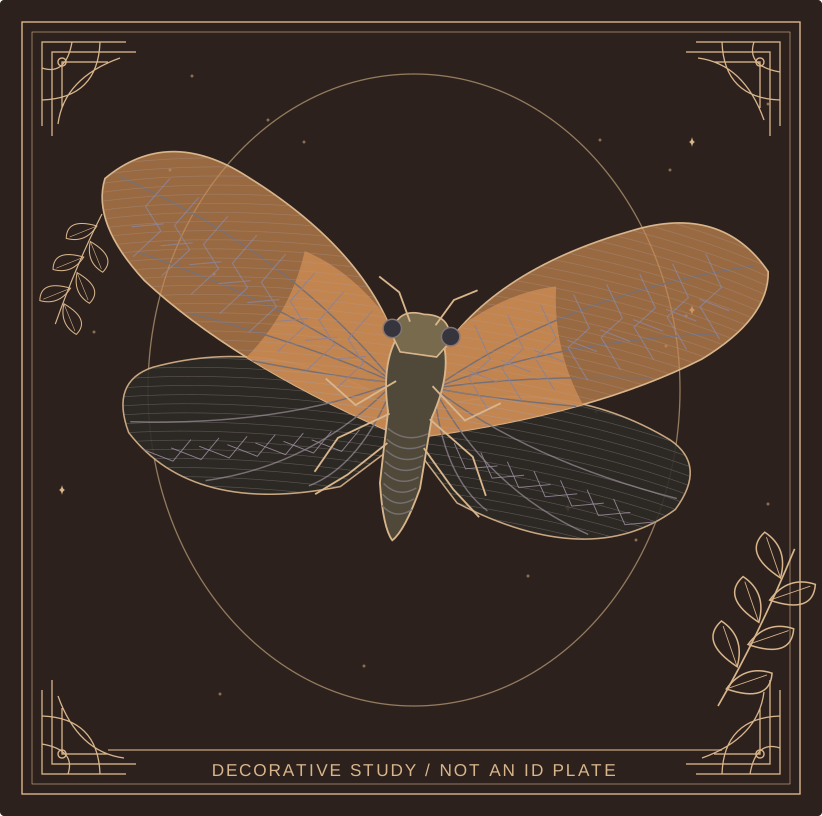
At a glance
- Research localities ↘
- Sequenced material included Vietnam and China. [4]
- Identity ↘
- A cicada, with no pupal stage. [6]
Meet the species
Taxonomic references do not agree on every name around electa. ITIS brings decorata and bifasciata into its synonymy; a recent comparative study discusses them separately. The supplied artwork label remains visible alongside this taxonomic disagreement. Higher classification changed too: the 2025 revision places Becquartinina within Leptopsaltriini. [1][2][3]
Becquartina electa is a cicada in Cicadidae, within the order Hemiptera. The informal label Black Orange Cicada introduces an artwork, but is not a formal taxonomic diagnosis. The name matters because studies of a related Becquartina cannot be used indiscriminately to fill this species’ life history. In particular, the 2024 discovery of B. bicolor in India is a different species account. [2]
Look closely
The comparative diagnosis describes electa with a broad, straight yellow band against darker wings. Related Becquartina can also be boldly patterned. The visible band offers a starting point for comparison, while a complete identification uses the appropriate specialist characters. [2]
Follow the straight band across the dark forewing and compare where its edges meet the veins. A preserved specimen is a three-dimensional surface, and color may change with lighting, mounting and age. The broad band is a useful comparative character in the cited diagnosis. It is one part of a specialist identification, rather than proof that every yellow-and-dark cicada must be electa. [2]
Range and habitat
The molecular study’s material included Bach Ma National Park in Vietnam and a locality in China. These are particularly useful anchors because they identify the material behind the genetic analysis. They do not show that the insect occupies every intervening landscape. The Thai checklist supplies an additional country record, while vegetation preferences and altitude limits require more detailed field evidence. [4][5]
Life in stages
At cicada-family level, the broad sequence is egg, nymph and adult. The nymph is not a caterpillar, and there is no pupal or chrysalis stage. Underground nymphs develop before a final molt produces the winged adult. A familiar cicada emergence image is therefore useful as background, but the underground duration of electa must not be borrowed from a North American periodical cicada. [6]
Food and host plants
The general cicada account describes plant-fluid feeding and underground nymphs associated with roots. That provides family-level context, not a verified electa host list. A named tree in a photograph can be a perch without proving feeding, breeding or root use. For this guide, those distinctions are more informative than a list of attractive plants assembled from unrelated cicadas. [6]
A living insect
Sound is central to the familiar experience of many cicadas. At family level, males produce calling signals with specialized organs, rather than by rubbing their wings together like a cricket. This is a useful introduction to a living cicada; the sources here do not establish electa’s exact call structure or daily schedule. The identity of a sound recording must be checked as carefully as the identity of an image. [6]
A remarkable detail
The broad wing band is visible at human scale, while the genetic study works at a very different scale. DNA evidence and external appearance can both contribute to classification, but neither should be reduced to a decorative rule. The specimens sequenced in a study are known research material. Their results do not authenticate an unrelated mounted individual solely because it looks similarly patterned. [4]
Connections in nature
A colorful adult is only one part of an insect’s relationship with its surroundings. Family-level root feeding supplies a starting point for thinking about plants and soil, while the documented range records place electa in particular Asian settings. Evidence for a predator-deterring color function, exact root hosts or a population trend would require additional species-specific observations. Those are different questions from recognizing the visible band. [6]
Names and discovery
Scientific names can remain recognizable while the higher groups around them change. The newer cicada classification and the older database synonymies describe that evolving framework. Showing the supplied name with the selected current treatment lets readers locate earlier work without pretending that every reference agrees. A disagreement in classification is useful context, not a reason to combine all related specimens into one indiscriminate natural-history story. [1][3]
Conservation context
A species account and a conservation assessment answer different questions. This guide does not assign a global threat category from the presence of specimens in collections or shops. A documented locality establishes an occurrence; it does not measure population size or trend. When learning more about conservation, check that an assessment concerns the same taxon, place and date. The collection or breeding history of an individual specimen must be established separately from the species’ natural range.
Reading the specimen
Dorsal means the upper surface; ventral means the underside. A reverse view can reveal information hidden by a spread upper view, but it represents the same animal. Compare orientation before comparing pattern. The pose, lighting and background of a mount can emphasize some features and conceal others. Neither a color-matched illustration nor an attractive spread photograph supplies a collecting locality, a sex determination or a subspecies identification by itself.
In the artwork
The saved framed works include Chaos and The Universe. Those names describe the compositions around the specimen: their imagery, mood and symbolic arrangement. They do not translate the cicada’s signal or establish the biological function of its colors. The artwork can remain evocative while its caption keeps a clear scientific name, an individual edition and the view being shown.
Care for the artwork
Place a framed specimen where you can enjoy its details in indirect light. Keep it away from damp rooms, radiators and abrupt changes of temperature. Handle the frame by its edges and keep the case closed; a wing, antenna or leg is more vulnerable than the surrounding glass suggests. Clean only the exterior, following the frame maker’s instructions, and avoid spraying liquid toward seams. If you notice loose fragments, moisture inside the case or signs of insect activity, photograph the change and seek conservation advice instead of opening the mount or applying a household pesticide.
Questions worth asking
Is the band proof of a warning signal? Its appearance is documented; the evolutionary function is not established here. Does every cicada have a 17-year cycle? This account does not assign electa the timetable of a different cicada. Is Black Orange Cicada a precise scientific name? It is an artwork-facing label; Becquartina electa is the research name. Can a song from B. bicolor stand in for electa? It cannot establish electa’s voice.
Explore the sources
The linked records serve different purposes: taxonomy establishes the name used here, field observations describe a place and population, and experiments explain a tested mechanism. Read those scopes alongside the photographs. A locality in a scientific paper belongs to its study material, not automatically to the insect behind a particular artwork.
- ITIS: Becquartina electa ↗
Integrated Taxonomic Information System · Accessed 2026-10-09
Lists electa with decorata and bifasciata synonymy; other recent literature differs.
- Sarkar and colleagues 2024: Becquartina comparative taxonomy ↗
Sarkar and colleagues; Zootaxa (2024) · Accessed 2026-10-04
Electa comparison supports dark wings and a broad straight yellow band. Natural history and Indian discovery of B. bicolor cannot be transferred to electa.
- Wang and colleagues 2025: phylogeny and revised cicada classification ↗
Wang and colleagues; Systematic Entomology (2025) · Accessed 2026-10-09
WAD cites page 725 for subjective synonymy of Gaeana cheni with G. maculata maculata. Also moves Becquartinina into Leptopsaltriini.
- Hill and colleagues 2021: cicada classification research ↗
Hill and colleagues; Invertebrate Systematics (2021) · Accessed 2026-10-09
Higher classification and genetic study; electa samples included Bach Ma National Park in Vietnam and a Chinese locality.
- Checklist of Thai cicadas, 2007 ↗
Sanborn, Phillips and Sites; Zootaxa (2007) · Accessed 2026-10-09
Country-level cicada records; presence does not establish habitat preference or specimen origin.
- Australian Museum: Cicadas ↗
Australian Museum · Accessed 2026-10-09
Cicada-level background only. Do not transfer Australian emergence schedules to Asian species.
Artworks in the collection
Explore the framed works and digital art connected with this insect. Etsy shows current availability, options and prices.
- Chaos ↗Framed work
- The Universe ↗Framed work
Continue exploring
Sources checked 2026-10-09. Artwork © Scott Schubr / Luminary Oddities.
Return to the Entomological Atlas ↑