

Luminary Oddities · Natural history & art
Batwing Cicada
Cryptotympana aquila
Hemiptera / Cicadidae
Dark wing bases and clear outer membranes belong to a Southeast Asian cicada whose song and microscopic wing surface have each been studied in detail.
Explore this insect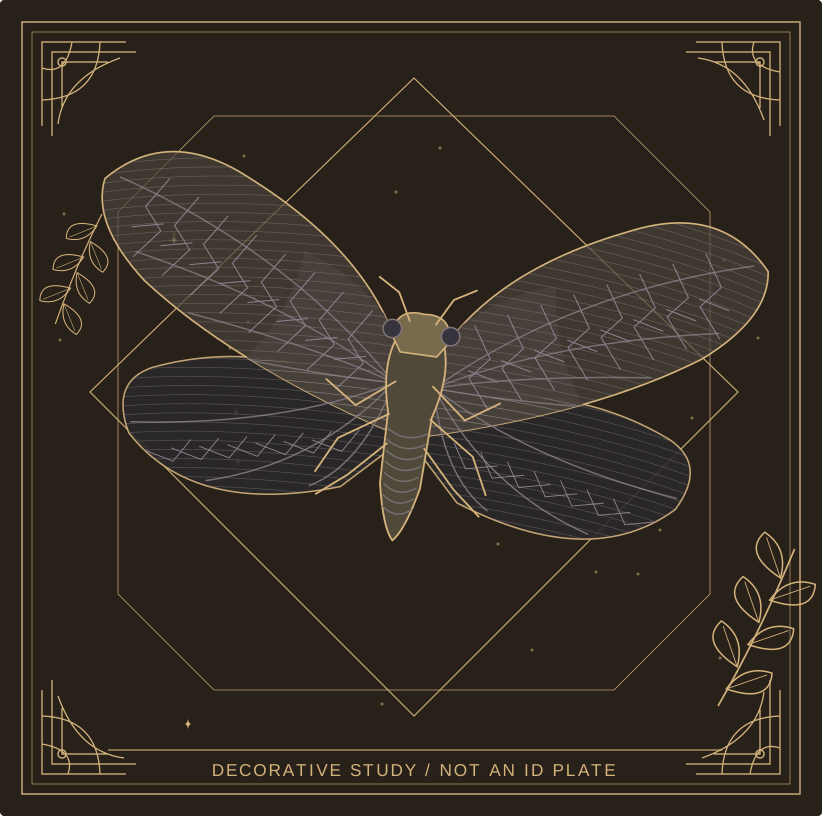
At a glance
- Wing science ↘
- Tested forewing surfaces showed a bactericidal effect. [5]
Meet the species
Cryptotympana aquila is a cicada in Cicadidae. The specialist database traces its original combination to Fidicina aquila and flags acquila as a misspelling. Keeping the spelling consistent is particularly useful when searching research on song or wing surfaces. An appealing label such as Batwing Cicada is a visual introduction; it does not imply that the insect belongs to bats or hunts like one. [1]
Look closely
Boulard’s examined material combines a glossy dark body with orange-brown coloration below, darker wing bases and clearer outer wing areas. Looking at both surfaces gives a better sense of that contrast than viewing a silhouette alone. The measurements in an individual description belong to its examined specimen, so this guide does not turn one recorded size into a universal species wingspan. [3]
Range and habitat
The Laos treatment lists occurrences in Vietnam, Laos, Thailand, Myanmar, Malaysia and Indonesia, including island and peninsular regions. It explicitly notes removal of the species from the Korean list. This is a valuable correction to the historical Corea type-label string. The record preserves history, while the modern distribution account evaluates how that history should be interpreted. [2]
Life in stages
The broad cicada life sequence has eggs, underground nymphs and a winged adult after the final molt. It has no pupa. The adult in a frame is therefore the visible end of a much less visible developmental history. Exact hosts, underground duration and a complete emergence calendar for aquila are not established by the sources selected here. [6]
Food and host plants
The museum introduces cicadas as plant-fluid feeders, with nymphs associated with roots. Those family features explain the general kind of feeding anatomy to look for. They do not identify aquila’s root host, preferred adult food plant or diet at every locality. A species can be well studied acoustically while its early-stage host relationships remain much less documented. [6]
A living insect
The Malaysian bioacoustic account describes stronger pulsed portions and lower-frequency connections within the signal. The sound’s structure can be examined without assigning a precise human translation to each portion. The recorded males are identified research material; that does not independently establish the sex of a source specimen used in an artwork. [4]
Gogala and Trilar connected identified Malaysian material with recorded signals, including caged insects stimulated by playback. That experimental setting matters: a response elicited in a cage is different from an entire daily calling routine in a forest. Their spectrograms and oscillograms give a way to see signal structure that the human description buzzing alone cannot capture. [4]
A remarkable detail
The surface comparison examined bacterial interactions with tested transparent forewing material. A measurable killing effect in that experimental system is a research result with particular conditions and organisms. It is not proof that every insect surface behaves identically. More importantly for a collection, it does not make a framed specimen sterile or support using it as an antibacterial material. [5]
Connections in nature
Song, plant feeding and a microscopic surface are different parts of the insect’s relationships with its surroundings. The acoustic paper documents signal structure and playback responses; the surface paper documents a laboratory interaction. Neither is a complete field account of predators or population dynamics. Keeping those questions distinct prevents a remarkable laboratory result from becoming an invented ecological role. [4][5]
Names and discovery
The specialist database interprets aquila as Latin for eagle and preserves the old Fidicina combination. The epithet is a naming detail, not evidence of predation or bird-like behavior. The modern range treatment also shows how a historical locality can be reconsidered. Scientific history is most useful when names, labels and later corrections remain visible together. [1][2]
Conservation context
A species account and a conservation assessment answer different questions. This guide does not assign a global threat category from the presence of specimens in collections or shops. A documented locality establishes an occurrence; it does not measure population size or trend. When learning more about conservation, check that an assessment concerns the same taxon, place and date. The collection or breeding history of an individual specimen must be established separately from the species’ natural range.
Reading the specimen
Dorsal means the upper surface; ventral means the underside. A reverse view can reveal information hidden by a spread upper view, but it represents the same animal. Compare orientation before comparing pattern. The pose, lighting and background of a mount can emphasize some features and conceal others. Neither a color-matched illustration nor an attractive spread photograph supplies a collecting locality, a sex determination or a subspecies identification by itself.
In the artwork
The framed listing offers Midnight and Gold editions. These presentations emphasize the dark body and the changing transparency of the wings against different backgrounds. Edition information belongs beside the image so that the viewer can understand the composition. It does not determine the specimen’s sex, and an artwork title is not a translation of the living cicada’s song.
Care for the artwork
Place a framed specimen where you can enjoy its details in indirect light. Keep it away from damp rooms, radiators and abrupt changes of temperature. Handle the frame by its edges and keep the case closed; a wing, antenna or leg is more vulnerable than the surrounding glass suggests. Clean only the exterior, following the frame maker’s instructions, and avoid spraying liquid toward seams. If you notice loose fragments, moisture inside the case or signs of insect activity, photograph the change and seek conservation advice instead of opening the mount or applying a household pesticide.
Questions worth asking
Why is Korea not shown as a confirmed range here? The modern Laos treatment records the species’ removal from the Korean list. Does aquila mean that it hunts other insects? It is a name allusion to an eagle, not evidence of that behavior. Do the laboratory wing results make a specimen hygienic? They establish a tested surface effect, not a product property. Does it have a chrysalis? Cicadas do not have a pupal stage.
Explore the sources
The linked records serve different purposes: taxonomy establishes the name used here, field observations describe a place and population, and experiments explain a tested mechanism. Read those scopes alongside the photographs. A locality in a scientific paper belongs to its study material, not automatically to the insect behind a particular artwork.
- World Auchenorrhyncha Database: Cryptotympana aquila ↗
World Auchenorrhyncha Database · Accessed 2026-10-09
Tacuini, Tacuina; original Fidicina combination. Aquila means eagle; acquila is an erroneous spelling.
- Lee 2014: Cicadas of Laos ↗
Lee; Annales de la Société entomologique de France (2014) · Accessed 2026-10-09
Aquila range includes Laos, Vietnam, Thailand, Malaysia, Indonesia and Myanmar. Does not support Korea.
- Boulard 2003: Thai cicadas including Gaeana cheni and Cryptotympana aquila ↗
Boulard; Annales de la Société entomologique de France (2003) · Accessed 2026-10-09
Historical cheni account: pp. 116–117, local Thai observations. Aquila account: pp. 98–100, examined material.
- Gogala and Trilar 2005: Cryptotympana aquila bioacoustics ↗
Gogala and Trilar; Serangga (2005) · Accessed 2026-10-09
Malaysian observations and caged playback work; distinguish observed sound structure from assumed communication function.
- Cicada Wing Surface Topography: bactericidal properties of nanostructural features ↗
Kelleher and colleagues; ACS Applied Materials & Interfaces · Accessed 2026-10-09
DOI 10.1021/acsami.5b08309. Studies colourless forewings. Significant killing reported for Megapomponia intermedia and Cryptotympana aquila; do not attribute the same result to Ayuthia. The paper uses aguila in places.
- Australian Museum: Cicadas ↗
Australian Museum · Accessed 2026-10-09
Cicada-level background only. Do not transfer Australian emergence schedules to Asian species.
Artworks in the collection
Explore the framed works and digital art connected with this insect. Etsy shows current availability, options and prices.
- Midnight & Gold editions ↗Framed work
Continue exploring
Sources checked 2026-10-09. Artwork © Scott Schubr / Luminary Oddities.
Return to the Entomological Atlas ↑