

Luminary Oddities · Natural history & art
Yellow-banded Cicada
Tacua speciosa
Hemiptera / Cicadidae
A large forest cicada whose bright collar stands out against a dark body. Malaysian field records add a daytime portrait, while its naming history explains a misleading old Indian attribution.
Explore this insect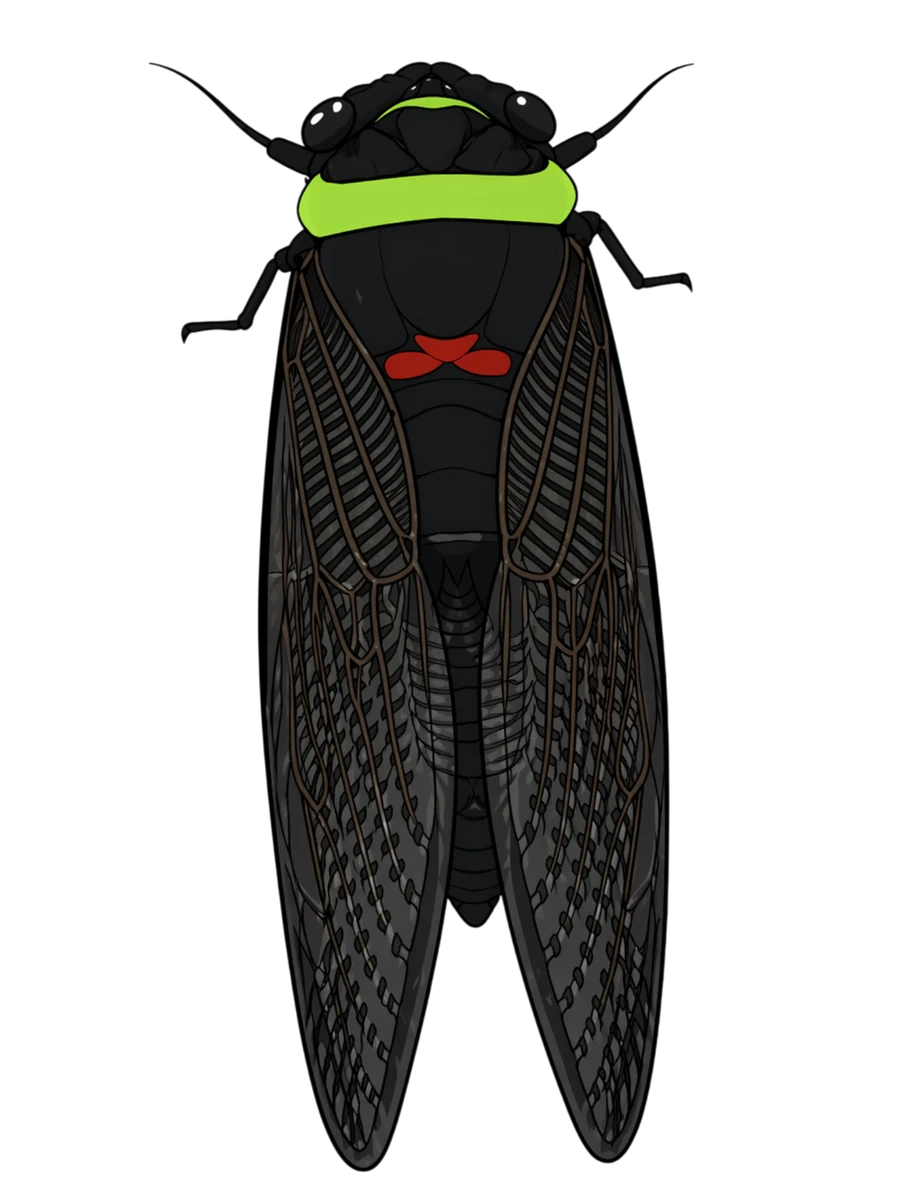
At a glance
- Field setting ↘
- Recorded in Sabah forest reserves. [5][6]
- Life stages ↘
- Egg, nymph and adult; no pupa. [7]
- Historical caution ↘
- The old Indian attribution was questioned. [4]
Meet the species
Tacua speciosa is a cicada in the family Cicadidae. Its identity is carried by the scientific name, while Yellow-banded Cicada, Green-banded Cicada and Emperor Cicada appear in Malaysian biodiversity and field accounts. These common names emphasize different features of the same named insect; they are not separate species entries. [3][5][6]
The accepted Catalogue of Life record, displayed by GBIF, lists the original Tettigonia speciosa and the later Cicada speciosa among its name combinations. The Atlas retains these as search aliases. Tacua’s genus record identifies speciosa as its type species, the species that anchors the genus name. [1][2]
Look closely
The Crocker Range researchers describe a large cicada with a band that can appear green or yellow. Their approximate body-length account is 5–6 centimetres. The Bukit Hampuan survey records one 55-millimetre individual. These measurements concern bodies in those reports, not a universal wingspan or a contest for the world’s largest insect. [6][5]
The collection’s dorsal artwork places a bright green collar and red thoracic marking against the dark body and folded wings. Fine veins run through the long forewings; the prominent eyes frame the head. These details describe that saved composition. A dorsal image partly hides the abdomen, so comparing it with a spread-wing or side view changes what can be seen.
Range and habitat
The modern regional catalog treats the taxon as occurring in Indonesia and Malaysia, while discussing doubtful older reports from India. The Malaysian national database includes Sabah. More precise field anchors come from the Crocker Range Forest Reserve and Bukit Hampuan Forest Reserve in Sabah, on Borneo. [4][3]
In Bukit Hampuan, a specimen was collected during daytime at about 1,500 metres. The survey’s reserve included upland dipterocarp and lower montane forest. In the Crocker Range account, Tacua was among the montane forest insects sampled. These reports connect identified adults to particular forest settings; they do not establish that every population occupies the same elevation. [5][6]
Life in stages
Cicadas develop through egg, nymph and adult stages without a pupa. Nymphs live underground and feed from roots. At the final molt an adult leaves its nymphal skin and expands its wings. The familiar empty shell is that shed skin, not a cocoon or a chrysalis. [7]
The Tacua records cited here concern adults. They do not establish an exact underground duration for the species. The well-known emergence cycles of particular North American cicadas cannot fill that gap: a shared family does not imply a shared seventeen-year schedule, synchronized population or seasonal trigger.
Food and host plants
The cicada family has piercing-and-sucking mouthparts, and both immature and adult stages obtain fluids from plants. Nymphs use roots; adults feed above ground. A tree on which a Tacua adult is perched is not necessarily a demonstrated feeding host or a larval host. [7]
A useful host record needs an identified plant and an observed connection to feeding or development. The Malaysian adult accounts do not provide such a complete host list. Forest occurrence is therefore preserved as habitat evidence instead of being converted into a menu of every tree in the surrounding reserve.
A living insect
The Crocker Range survey sampled Tacua during daytime on tree branches or shrubs and did not attract it to the survey’s light trap. That is a direct field observation with a method attached. It does not prove that no individual ever moves at night or approaches another kind of light. [6]
For cicadas generally, male sound is made with tymbal organs rather than by rubbing wings together. A photograph cannot preserve a song, and a species’ name alone does not identify the sex of the source specimen. The linked Tacua field notes do not supply a measured acoustic description here. [7]
A remarkable detail
Tacua illustrates a historical naming problem with real consequences for maps. Cicada indica, an old name now linked to speciosa, helped carry an Indian attribution into later literature. The 2016 catalog revisits that history and treats an Indian origin as unlikely. A place suggested by the word indica is weaker evidence than a documented, checked specimen locality. [4]
The correction is worth remembering whenever a scientific name sounds geographical. Names persist through later reinterpretation; they are not themselves occurrence records. An old label, a taxonomist’s criticism and a current catalog can tell a more complicated story than the name alone.
Connections in nature
The daytime Tacua encounters occur within surveys of much broader insect communities. A forest insect can be documented by active observation even when it is absent from a light-trap sample. Looking at multiple methods helps explain why a visually conspicuous species may be represented differently in separate inventories. [6]
That connection between method and record is practical for appreciating any Atlas species. A single specimen establishes that an animal was encountered, while repeated, comparable observations are needed to describe abundance or change. Beautiful photographs and rigorous survey records can complement each other without answering identical ecological questions.
Names and discovery
Illiger’s name dates to 1800. Amyot and Audinet-Serville established Tacua in 1843, with Tettigonia speciosa as the type species by original monotypy. In plain terms, the genus was originally built around this species. The current taxonomic databases connect that older wording to the name used in the Atlas. [1][2]
The national Malaysian record uses Yellow-banded Cicada, while another field paper uses Green-banded Cicada. Common names can vary with language, observer and the feature emphasized. The scientific name provides a stable search bridge across those accounts without requiring every artwork title to use the same vernacular phrase. [3]
Conservation context
The Bukit Hampuan researchers documented habitat pressures, including past fire and agricultural encroachment, and recommended stronger forest connectivity. Those conclusions concern the reserve and its insect community. They give useful conservation context for a recorded Tacua locality without proving a species-wide decline or supplying a global threat category. [5]
The cited sources do not establish a current global assessment for Tacua speciosa. Preserve the original specimen information when it is available, and distinguish a local encounter from a worldwide population conclusion. A newly documented place can improve the map even when it tells us little about population size.
Reading the specimen
Dorsal means the view from above; ventral means the underside. A folded-wing view keeps the body’s compact silhouette, while a spread view exposes more of the abdomen and hindwings. Follow the vein pattern and body boundaries before comparing color across views. Artistic finish, background and illumination can all alter how much detail remains visible.
In the artwork
Three Tacua speciosa digital packs preserve the insect as a recognizable subject through different poses and treatments. The bright collar punctuates the dark body, and the long forewings supply much of the outline. The works derive from specimen photography; their compositions offer a human interpretation of that recorded body rather than a measurement of flight or behavior.
Care for the artwork
For a digital work, keep the original download and its license together, and make a backup before cropping or preparing a print. Choose paper, inks and framing for the display location; a bright screen preview and a paper print will not necessarily look identical. Avoid direct sunlight and damp locations for a finished print. The insect-derived artwork is an interpretation of the original photograph, so resizing it or changing its color balance changes the artwork rather than the biological specimen.
Questions worth asking
Is this a butterfly with unusual wings? It is a cicada, in Hemiptera rather than Lepidoptera. Does it form a pupa? Cicadas do not have a pupal stage. Does the name Cicada indica prove that it occurs in India? The historical attribution was questioned in the modern catalog. Does a daytime observation establish the complete daily activity cycle? It records what the researchers saw under their survey conditions.
Explore the sources
The linked records serve different purposes: taxonomy establishes the name used here, field observations describe a place and population, and experiments explain a tested mechanism. Read those scopes alongside the photographs. A locality in a scientific paper belongs to its study material, not automatically to the insect behind a particular artwork.
- Tacua speciosa (Illiger, 1800) ↗
Catalogue of Life via GBIF · Accessed 2026-10-09
Accepted species and older name combinations.
- Tacua Amyot & Audinet-Serville, 1843 ↗
World Auchenorrhyncha Database · Accessed 2026-10-09
Genus nomenclature and type species.
- Tacua speciosa: Yellow-banded Cicada ↗
Malaysia Biodiversity Information System, Malaysia Biodiversity Centre · Accessed 2026-10-09
National species record and Sabah occurrence context.
- The cicadas of India, Bangladesh, Bhutan, Myanmar, Nepal and Sri Lanka: an annotated provisional catalogue ↗
Price and colleagues; Biodiversity Data Journal (2016) · Accessed 2026-10-09
Museum-based catalog discussion of doubtful Indian attribution and Indonesia/Malaysia range.
- Insect diversity of Bukit Hampuan Forest Reserve, Sabah, Malaysia ↗
Chung and colleagues; Journal of Threatened Taxa (2013), primary article copy · Accessed 2026-10-09
2010 adult record, measured individual, locality and reserve-wide conservation context.
- Diversity and Geographical Ranges of Insects in Crocker Range Forest Reserve, Sabah, Malaysia ↗
Chung and colleagues; Journal of Tropical Biology and Conservation (2016) · Accessed 2026-10-09
2011 survey, green/yellow band, adult size account, daytime perch observation and light-trap result.
- Cicadas: Superfamily Cicadoidea ↗
Australian Museum · Accessed 2026-10-09
Family-level development, feeding and male sound anatomy; Australian development periods not transferred to Tacua.
Artworks in the collection
Explore the framed works and digital art connected with this insect. Etsy shows current availability, options and prices.
- Emperor Rainforest Cicada PNG Pack 1 of 3 | 34 Tacua speciosa 300 DPI Digital Insect Clipart Files ↗Digital artwork
- Emperor Rainforest Cicada PNG Pack 2 of 3 | 28 Tacua speciosa 300 DPI Digital Insect Clipart Files ↗Digital artwork
- Emperor Rainforest Cicada PNG Pack 3 of 3 | 21 Tacua speciosa 300 DPI Digital Insect Clipart Files ↗Digital artwork
Continue exploring
Sources checked 2026-10-09. Artwork © Scott Schubr / Luminary Oddities.
Return to the Entomological Atlas ↑